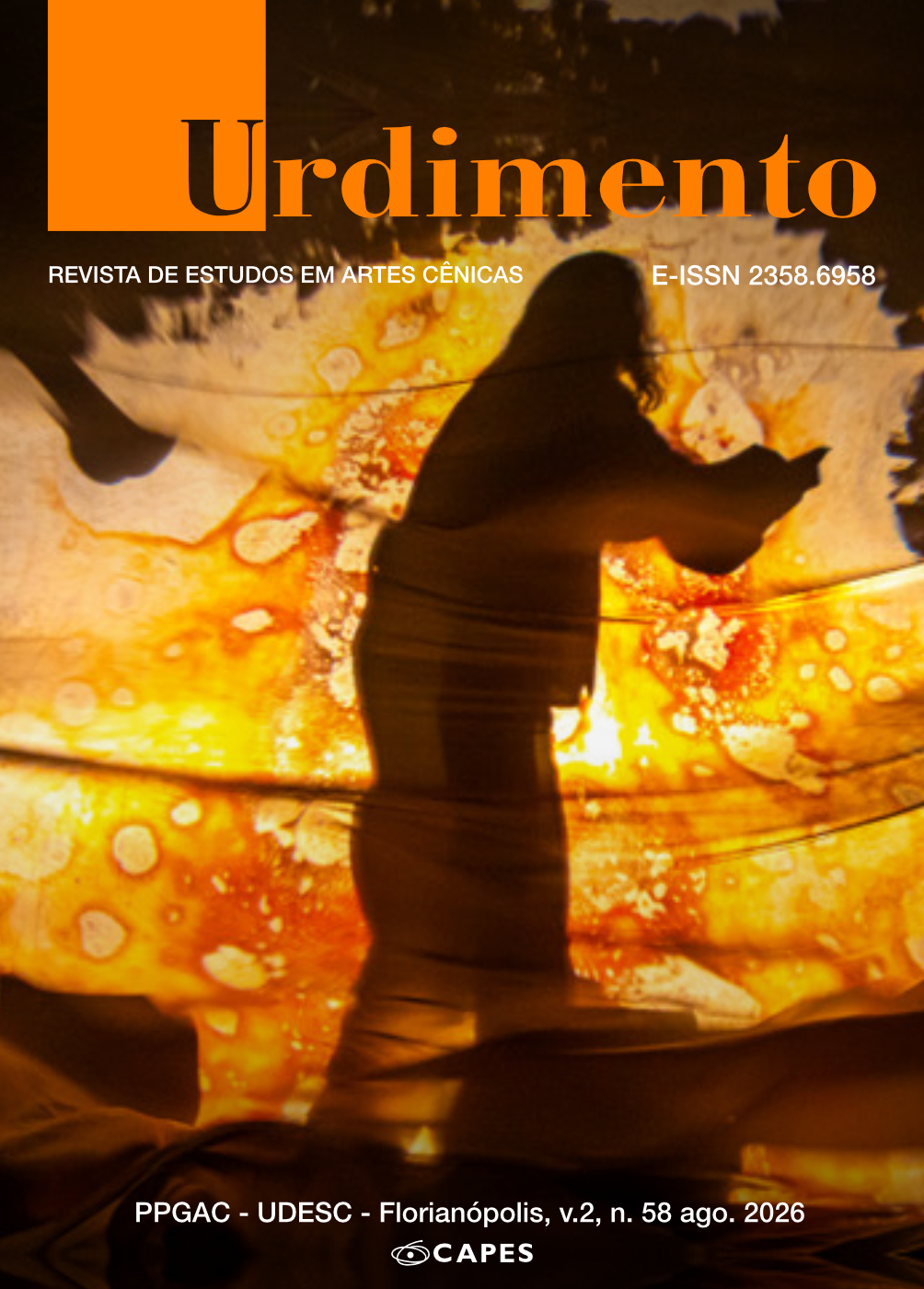
Afro-Brazilian spatial practices and scenic-performative visualities in the appearance of “Nego Fugido”
DOI:
https://doi.org/10.5965/1414573102582026e0204Keywords:
Afro-Brazilian scenography, spatial practices, visualitiesAbstract
This study investigated Afro-Brazilian spatial practices and scenic-performative visualities in the appearance of “Nego Fugido” which aim to discuss the existence of Afro-Brazilian scenography. The methodology included bibliographic analysis and participant observation of the manifestation. The results revealed that “Nego Fugido” operates through hybrid visualities and spatial practices, connecting ritualistic, political, and ancestral dimensions. The discussion pointed to the expansion of the concept of scenography, incorporating Afro-Pindoramic knowledge. As a result, it is suggested that further studies on other cultural manifestations be conducted to consolidate an alternative theoretical framework.
Downloads
References
ALEXANDRE, Marcos A. O saber popular e sua influência na construção das representações sociais. Comum, v. 5, n. 15, p. 161-171, 2000.
ALEXANDRE, Marcos A. Formas de representação do corpo negro em performance. Repertório: Teatro e Dança, v. 12, n. 12, p. 104-114, 2012.
ARONSON, Arnold. Looking into the Abyss: Essays on Scenography. 5th. ed. [S.l.]: The University of Michigan Press, 2011.
HOWARD, Pamela. O que é cenografia? São Paulo: Edições SESC São Paulo, 2015.
MARTINS, Leda Maria. Performances do tempo espiralar, poéticas do corpo-tela. Rio de Janeiro: Cobogó, 2021.
MARTINS, Leda Maria. A cena em sombras. 2. ed. São Paulo: Perspectiva, 2023.
MCKINNEY, Joslin; PALMER, Scott. Scenography expanded. London: Bloomsbury, 2017.
PEREIRA, Edimilson de Almeida. Entre Orfe(x)u e Exunouveau: análise de uma estética de base afrodiaspórica na literatura brasileira. São Paulo: Fósforo, 2022. v. 1.
PINTO, Monilson dos Santos. A bananeira que sangra: desobediência epistêmica, pedagogias e poéticas insurgentes nas aparições do Nego Fugido. 2021. Tese (Doutorado em Artes Cênicas) – Universidade de São Paulo, São Paulo, 2021.
REBOUÇAS, Renato Bolelli. Espaços e materiais residuais em potência performativa: Cenografia expandida a partir do Sul. 2021. Tese (Doutorado em Artes Cênicas) – Universidade de São Paulo, São Paulo, 2021.
RODRIGUES, Cristiano C. Capoeira e cenografia: diálogos possíveis pelo espaço. Urdimento - Revista de Estudos em Artes Cênicas, v. 2, n. 38, p. 1-26, 24 set. 2020.
RODRIGUES, Cristiano C. Cenografia: outros modos de experimentar e prática. 2013. Tese (Doutorado em Arquitetura e Urbanismo) - Universidade Federal de Minas Gerais, Belo Horizonte, 2013.
SANTOS, Antônio Bispo dos. A terra dá, a terra quer. São Paulo: Ubu Editora/PISEAGRAMA, 2023.
SANTOS, Antônio Bispo dos. Colonização, Quilombos: modos e significações. Brasília: Ayô, 2015.
SCHECHNER, Richard. Environmental Theater. 2. ed. New York: Applause Books, 1994.
SIMÕES, Igor Moraes. Onde estão os negros? Apagamentos, racialização e insubmissões na arte brasileira. PORTO ARTE: Revista de Artes Visuais, [S. l.], v. 24, n. 42, 2019. Acesso em: 19 mai. 2025. DOI: 10.22456/2179-8001.98263.
SIMÕES, Igor Moraes. Todo cubo branco tem um quê de Casa Grande: racialização, montagem e histórias da arte brasileira. PHILIA: Filosofia, Literatura & Arte, v. 3, n. 1, p. 314-329, 2021.
SODRÉ, Muniz. O terreiro e a cidade: a forma social negro-brasileira. Petrópolis, RJ: Vozes, 1998.
WAWZYNIAK, João Valentin. “Engerar”: uma categoria cosmológica sobre pessoa, saúde e corpo. Ilha, v. 5, n. 2, p. 33-55, dez. 2003.
Published
Issue
Section
License
Copyright (c) 2026 Urdimento: Revista de Estudos em Artes Cênicas

This work is licensed under a Creative Commons Attribution 4.0 International License.
Copyright Statement
The articles published by the magazine are free to use. The copyright is all assigned to the magazine. The articles whose authors are identified represent the expression from the point of view of their authors and not the official position of the journal Urdimento. The author (s) undertakes whenever publishing material relating to the article published in Revista Urdimento mention the said publication as follows: This article was originally published by Urdimento magazine in its volume (put the volume), number (put the number) in the year of (put the year) and can be accessed at:
http://www.revistas.udesc.br/index.php/urdimento
This work is licensed under a Creative Commons Attribution 4.0 International License.