From the Mineiro Land, the Color: pigments of Minas Gerais between geology, body and painting
DOI:
https://doi.org/10.5965/2175234618452026e0014Keywords:
Mineral pigments, Iron oxides, Contemporary painting, Monochrome, Body of colorAbstract
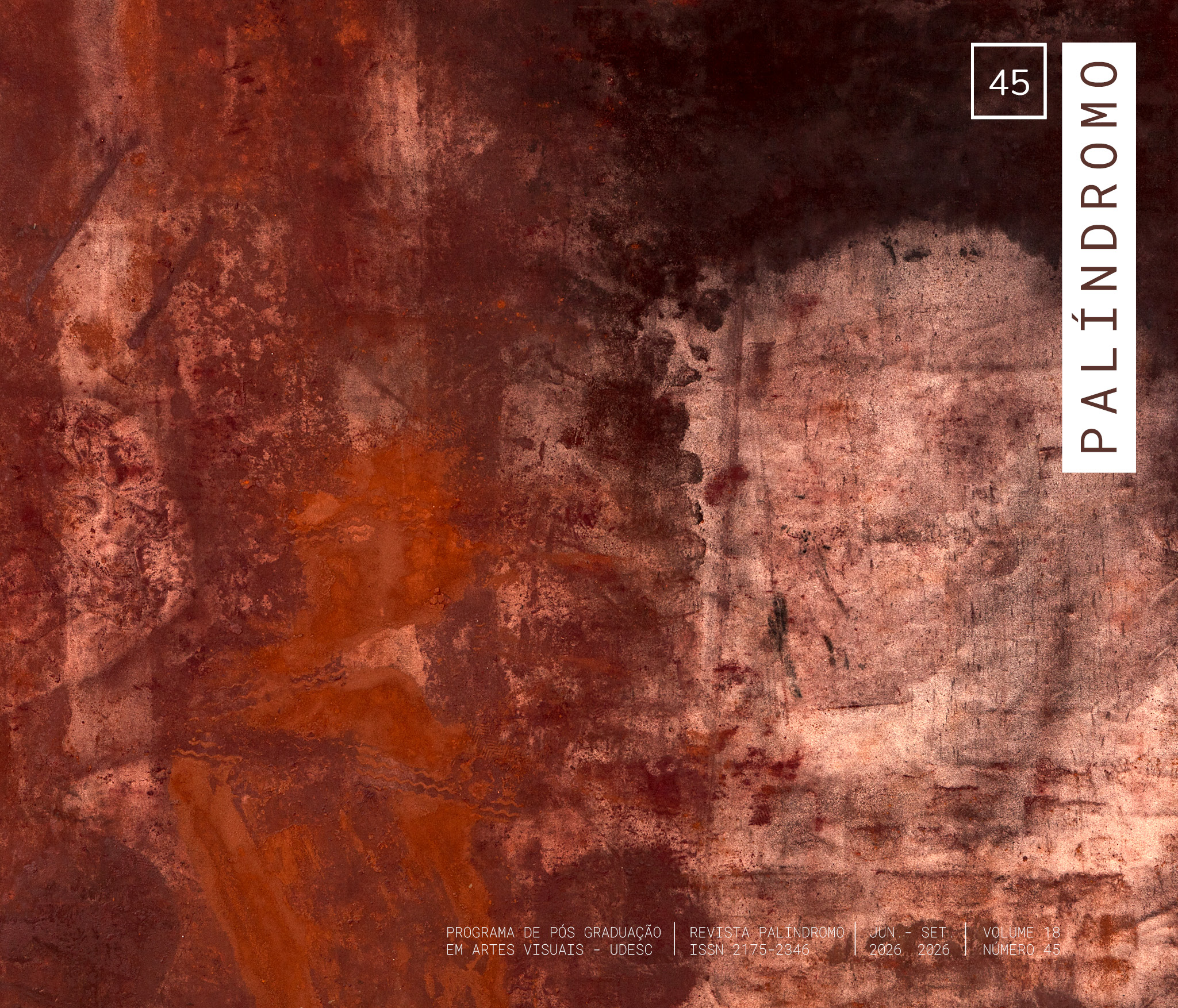
In contemporary painting, color is often treated as a visual effect, and its material origin is rarely considered. This article examines the material dimension of color, based on natural pigments of Brazilian origin, especially the iron oxides extracted from the Quadrilátero Ferrífero, in Minas Gerais. Its objective is to understand color as a field in which geological, historical, industrial, and affective processes intersect. The methodology combines an analysis of Carlos Vergara’s interview with Fabíola Salles Mariano, published in ARS, with a survey of the history of the company Óxido de Ferro Rio Acima and of the artisanal paint catalog of Joules & Joules, as well as field observation during a visit to the factory in March 2026. The results show the shift from pigment as event, unstable, ritual, and affective, to pigment as industrial protocol, without this transformation eliminating the potency of matter. On this basis, the monochrome is reframed as a field of temporal condensation, and Marco Giannotti’s notion of the body of color brings the experience of the factory closer to the tradition of Hélio Oiticica’s Bólides. The article concludes that color takes shape as a network of passages among the mine, the factory, and the painted surface.
Downloads
References
DUARTE, Paulo Sergio (org.). Carlos Vergara: pinturas. Rio de Janeiro: Automática, 2011.
FAVARETTO, Celso. A invenção de Hélio Oiticica. São Paulo: Edusp, 1992.
GIANNOTTI, Marco. O corpo da cor. Revista Estado da Arte, Uberlândia, v. 4, n. 2, p. 1-14, jul./dez. 2023. Disponível em: https://doi.org/10.14393/EdA-v4-n2-2023-73352. Acesso em: 10 abr. 2026.
GOETHE, Johann Wolfgang von. Doutrina das cores. Apresentação, seleção e tradução de Marco Giannotti. São Paulo: Nova Alexandria, 1993.
ICMBIO. Primeiro sítio arqueológico descoberto na Serra da Capivara completa 50 anos. Brasília, DF: ICMBio, 17 ago. 2023. Disponível em: https://www.gov.br/icmbio/pt-br/assuntos/noticias/ultimas-noticias/primeiro-sitio-arqueologico-descoberto-na-serra-da-capivara-completa-50-anos. Acesso em: 10 abr. 2026.
JOULES & JOULES. Terras Brasileiras Joules & Joules. São Paulo, 2026. Disponível em: https://www.joulesejoules.com/tinta-a-oleo-artesanal-terras-brasileiras-joules. Acesso em: 10 abr. 2026.
MARIANO, Fabíola Salles. Entrevista com Carlos Vergara em 22 de outubro de 2013. ARS, São Paulo, ano 12, n. 23, p. 24-35, 2014.
ÓXIDO DE FERRO RIO ACIMA. Histórico da empresa Óxido de Ferro Rio Acima. Rio Acima, 2026. Disponível em: https://oxidodeferrorioacima.com.br/pt/pigmentos/. Acesso em: 10 abr. 2026.
PEDROSA, Mário. Arte ambiental, arte pós-moderna, Hélio Oiticica. In: OITICICA, Hélio. Aspiro ao grande labirinto. Rio de Janeiro: Rocco, 1986. p. 9-13.
SOUSA, W. T. de; MERSCHMANN, L. H. de C.; SILVA, J. T. G. da. Iron ore review 1990-1998. REM: Revista Escola de Minas, Ouro Preto, v. 55, n. 1, p. 43-48, 2002.
VERGARA, Luiz Guilherme. Carlos Vergara: Sudário. Coordenação de Carlos Vergara. Tradução de Alex Forman. Rio de Janeiro: Automática, 2014.
Downloads
Published
Issue
Section
License
Copyright (c) 2026 Jean Carlos Smekatz

This work is licensed under a Creative Commons Attribution 4.0 International License.
COPYRIGHT STATEMENT
The articles published by the magazine are free to use, intended for academic and non-commercial applications. Copyright is all assigned to the magazine. The articles whose authors are identified represent the expression from the point of view of their authors and not the official position of Palíndromo Magazine. The author (s) commits to whenever they publish material referring to the article published in Palíndromo mention this publication as follows:
This article was originally published by Palíndromo magazine in its volume (place the volume), number (place the number) in the year of (place the year) and can be accessed at: http://www.revistas.udesc.br/index.php/palindromo