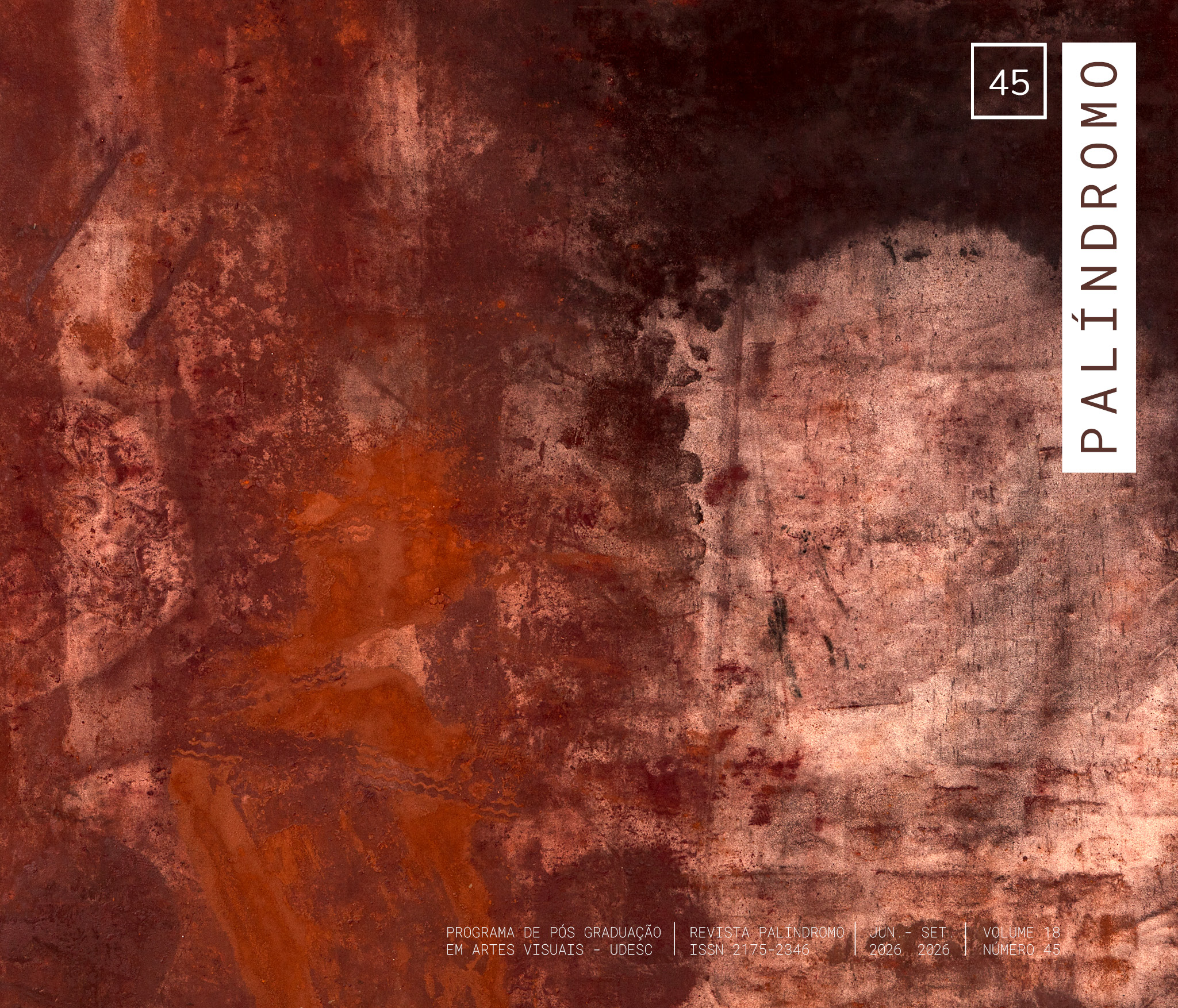
The pigment that emerges from the landscape and returns to painting as poetic and symbolic material
DOI:
https://doi.org/10.5965/2175234618452026e0004Keywords:
Mineral pigments, Tempera, Painting, Landscape, Sensory ExperienceAbstract
Based on fieldwork in the rural area of Formiga (MG), this study investigates natural mineral pigment as a poetic and symbolic material in painting. The objective is to understand the journey of the pigment that originates in the earth, reveals itself in the landscape, and returns to it as painting, transforming the artist's sensory experience into an image. The results show that the encounter with colored earth transcends the simple imitation of nature, configuring itself as an aesthetic experience capable of converting emotions, memories, and perceptions into a pictorial work. It is concluded that the journey from earth to painting updates ancestral knowledge in contemporary artistic practice and constitutes the work as poetic and symbolic material, articulating nature and art, permanence and transformation.
Downloads
References
CORDEIRO, Miriam Costa. A tessitura da crítica benjaminiana [manuscrito] : entre os românticos e Goethe. Dissertação. (Mestrado em Estética e Filosofia da Arte) - Universidade Federal de Ouro Preto, 2010.
DEBERDT, André Jean. Mineração na Serra do Curral. OECO, 2021. Disponível em: https://oeco.org.br/analises/mineracao-ameaca-mais-uma-vez-a-serra-do-curral/. Acesso em: 27 abr. 2026.
FONSECA, Anísio Cláudio Rios. Geologia geral do município de Formiga, MG. Formiga: Centro Universitário de Formiga, Laboratório de Mineralogia, 2008.
GIANNOTTI, Marco. O corpo da cor. Revista Estado da Arte, Uberlândia, v. 4, n. 2, p. XX-XX, jul./dez. 2023.
GIANNOTTI, Marco. Recortes sobre a cor Transformações cromáticas da pintura brasileira: do modernismo à arte contemporânea. Revista Apotheke, Florianópolis, v. 2, n. 3, 2017. DOI: 10.5965/24471267232016090. Disponível em: https://revistas.udesc.br/index.php/apotheke/article/view/9068. Acesso em: 9 jul. 2026.
GIANNOTTI, Marco. Volpi ou a reinvenção da têmpera. São Paulo: [s.n.], 2006.
GONÇALVES, Adriana Honorato. Pintura: materiais e procedimentos para a pintura. São Paulo: Universidade Cruzeiro do Sul, [s.d.].
LAMPERT, Jociele. et al. Conversas Pictóricas. Florianópolis: Editora UDESC, 2019.
LÍDER TERRAPLANAGEM. O corte de barranco. 13 mar. 2023. Disponível em: https://www.instagram.com/p/C4eDf2Sxlw-/?img_index=4. Acesso em: 22 abr. 2026.
LIMA, Caio Vieira da Silva Villa; SILVA, Tharciana Goulart da; LAMPERT, Jociele. A prática de pintura a partir dos pigmentos da terra na formação de artistas professores. Revista Apotheke, Florianópolis, v. 8, n. 3, p. 110-124, 2022.
MAYER, Ralph. Manual do artista: técnicas e materiais. 5. ed. São Paulo: Martins Fontes, 2015.
MORI, Eva Kaiser. Caracterização de pinturas do artista Alfredo Volpi por meio de métodos não destrutivos: espectrofotômetro, EDXRF, MEV e imageamento multiespectral. 2015. Dissertação (Mestrado em Geociências) – Universidade de São Paulo, São Paulo, 2015. Disponível em: https://teses.usp.br/teses/disponiveis/44/44144/tde-17112015-151200/. Acesso em: 26 abr. 2026.
OLIVEIRA, Darli Reinalda Pinto. Arqueologia do fazer: uma trajetória e o uso tecno-expressivo dos pigmentos na fatura da têmpera. Uberlândia, 1996.
OLIVEIRA, Giovanni Bueno de. Geologia faz arte: origem e uso de pigmentos minerais na arte pictórica. São Paulo, 2022.
SALLES, Cecília Almeida. O gesto Inacabado: processo de criação artística. 3ª edição, São Paulo: FAPESP, 2007.
SILVEIRA, Luciana Martha. Introdução à teoria da cor. 2. ed. Curitiba: UTFPR, 2015.
Downloads
Published
Issue
Section
License
Copyright (c) 2026 Maria José Boaventura

This work is licensed under a Creative Commons Attribution 4.0 International License.
COPYRIGHT STATEMENT
The articles published by the magazine are free to use, intended for academic and non-commercial applications. Copyright is all assigned to the magazine. The articles whose authors are identified represent the expression from the point of view of their authors and not the official position of Palíndromo Magazine. The author (s) commits to whenever they publish material referring to the article published in Palíndromo mention this publication as follows:
This article was originally published by Palíndromo magazine in its volume (place the volume), number (place the number) in the year of (place the year) and can be accessed at: http://www.revistas.udesc.br/index.php/palindromo