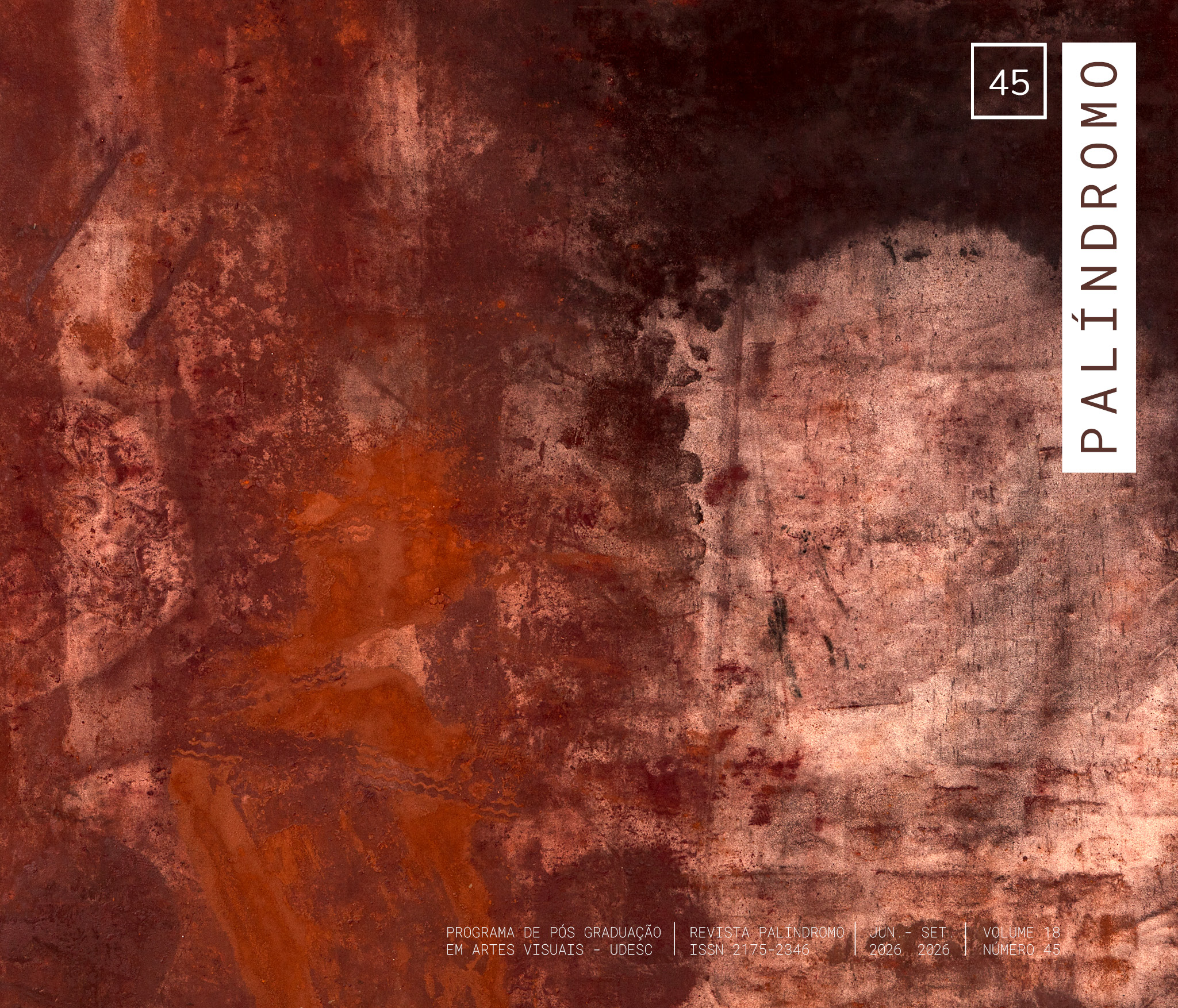
Painting on a Razor’s Edge: Chromatic Mutations in Brazilian Lands
DOI:
https://doi.org/10.5965/2175234618452026e0012Keywords:
Territory, Brazilian biomes, Painting, Pigments, PaintsAbstract
This article investigates the possibilities of translating the chromatic qualities of Brazilian lands onto the pictorial surface. Its objective is to present concepts and procedures that contribute to the poetic choices preceding the act of painting, considering the particularities of Brazilian biomes and the transformations involved in transferring materials into painting. The methodology combines a theoretical review of art, philosophy, and color theory with an analysis of pictorial and material procedures, focusing on the atmospheric circulation of matter, the production of pigments and paints, and the relationships between artisanal techniques and contemporary technologies. The study identifies possibilities for exploring the physical properties of pigments, chromatic interactions, textures, and variations in transparency and opacity in the construction of pictorial palettes. It concludes that translating the chromatic qualities of Brazilian lands involves choices that take into account material characteristics, perceptual experience, and the artist’s repertoire. Pictorial practice thus opens up possibilities for investigating chromatic identities associated with territories.
Downloads
References
ARNEIL, Barbara. A carne do cervo do índio selvagem: a teoria da propriedade de Locke e o colonialismo inglês na América. Tradução de Virgínia H. Ferreira da Costa. Cadernos de Ética e Filosofia Política, São Paulo, v. 44, n. 2, p. 213–230, 2025. DOI: https://doi.org/10.11606/issn.1517-0128.v44i2p213-230. Acesso em: 17 out. 2026.
BOYD, Carolyn E. Colours of the ancient world. YouTube, 2023. Disponível em: https://www.youtube.com/watch?v=le6ZkiFHJ9Y. Acesso em: 17 abr. 2026.
CALVINO, Italo. Seis propostas para o próximo milênio. São Paulo: Companhia das Letras, 1990.
CARNEIRO, Rafael; DUNLEY, Bruno. Relatos compartilhados no educativo da Joules and Joules. Aula/atividade educativa. Joules and Joules, 2025.
EASTAUGH, Nicholas et al. Pigment Compendium: A Dictionary of Historical Pigments. Oxford: Elsevier, 2004.
FORTES, Hugo Fernando Salinas. Poéticas líquidas: a água na arte contemporânea. 2006. Tese (Doutorado em Artes Visuais) – Escola de Comunicações e Artes, Universidade de São Paulo, São Paulo, 2006. p. 143.
GAGE, John. Colour and Culture: Practice and Meaning from Antiquity to Abstraction. London: Thames & Hudson, 2024. 448 p. ISBN 978-0-500-02793-6.
GIANNOTTI, Marco. From Goethe to Rothko: new ways of perceiving and creating through color. Apresentação de seminário no AIC 2026 Midterm Meeting, Gruppo del Colore, Palazzo Vecchio, Florença, Itália, 2026.
GIANNOTTI, Marco. O corpo da cor. Revista Estado da Arte, Uberlândia, v. 4, n. 2, 2023. DOI: 10.14393/EdA-v4-n2-2023-73352.
GIANNOTTI, Marco. Transformações cromáticas da pintura brasileira: do modernismo à arte contemporânea. Revista Apotheke, Santa Catarina, v. 4, n. 2, p. 90–116, 2016. ISSN 2447-1267.
GOETHE, Johann Wolfgang von. Doutrina das cores. Apresentação, tradução, seleção e notas de Marco Garaude Giannotti. São Paulo, Nova Alexandria, 2011. 212 p.
IBGE. Expedição chega à área de contato entre Caatinga, Cerrado e Mata Atlântica. Agência de Notícias IBGE, 3 jul. 2018. Disponível em: https://agenciadenoticias.ibge.gov.br/agencia-noticias/2012-agencia-de-noticias/noticias/21600-expedicao-chega-a-area-de-contato-entre-caatinga-cerrado-e-mata-atlantica. Acesso em: 17 out. 2026.
MARIANI, Anna. Pinturas e platibandas. 2. ed. rev. e ampl. São Paulo: Instituto Moreira Salles, 2010.
MARIANO, Fabíola Salles. Entrevista com Carlos Vergara em 22 outubro de 2013. ARS, São Paulo, v. 12, n. 23, p. 23–35, 2014. Disponível em: https://doi.org/10.11606/issn.2178-0447.ars.2014.82831. Acesso em: 18/10/2026
MAYER, Ralph. Manual do artista: de técnicas e materiais. 5. ed. São Paulo: Editora Martins Fontes, 2016.
MUHS, Daniel R.; BUDAHN, James R.; PROSPERO, Joseph M.; SKIPP, Gary; HERWITZ, Stanley R. Soil genesis on the island of Bermuda in the Quaternary: the importance of African dust transport and deposition. Journal of Geophysical Research: Earth Surface, v. 117, F03025, 2012. https://doi.org/10.1029/2012JF002366.
REYNOLDS, Louise. Salt texture techniques for watercolour and wet media. Jackson's Art Blog, 16 dez. 2025. Disponível em: https://www.jacksonsart.com/blog/2025/12/16/salt-texture-techniques-for-watercolour-and-wet-media/. Acesso em: 19 abr. 2026.
SEINFELD, J. H.; PANDIS, S. N. Atmospheric chemistry and physics: from air pollution to climate change. 3. ed. Hoboken: John Wiley & Sons, Inc., 2016. ISBN 978-1118947401 (cloth); ISBN 978-1119221166 (pdf); ISBN 978-11191221173 (epub).
SIGNAC, Paul. De Eugène Delacroix ao neo-impressionismo. São Paulo: Intermezzo editorial, 2016.
VEZZOLI, Luigina. Geological Contributions to the History of the Artist’s Iron-Based Natural Earth Pigments. Colorants, 2026.
Downloads
Published
Issue
Section
License
Copyright (c) 2026 Anabel Lí

This work is licensed under a Creative Commons Attribution 4.0 International License.
COPYRIGHT STATEMENT
The articles published by the magazine are free to use, intended for academic and non-commercial applications. Copyright is all assigned to the magazine. The articles whose authors are identified represent the expression from the point of view of their authors and not the official position of Palíndromo Magazine. The author (s) commits to whenever they publish material referring to the article published in Palíndromo mention this publication as follows:
This article was originally published by Palíndromo magazine in its volume (place the volume), number (place the number) in the year of (place the year) and can be accessed at: http://www.revistas.udesc.br/index.php/palindromo